
Injection Molded Magnets vs. Sintered Magnets: A Complete Guide for Automotive Sensors
Discover the critical differences between injection molded magnets and sintered magnets. Learn why automotive sensor engineers increasingly prefer molded magnetic rotors for precision, cost-efficiency, and complex geometries.
Injection Molded Magnets vs. Sintered Magnets: A Complete Guide for Automotive Sensors
When designing automotive sensors—such as throttle pedal sensors, steering angle sensors, or ABS encoders—engineers are frequently faced with a critical choice: should you use an injection molded magnet or a traditional sintered magnet?
In the past, sintered magnets (like Neodymium or Samarium Cobalt) were the default choice due to their extremely high magnetic strength. However, as automotive systems demand more complex geometries, tighter tolerances, and fully integrated sub-assemblies, injection molded magnets have emerged as the superior choice for most sensor applications.
This article details the core engineering differences, exact tolerance capabilities, and the rationale behind specifying injection molded magnetic rotors for modern automotive sensors.
1. Core Comparison: Magnetic Strength vs. Dimensional Precision
Sintered Magnets (The Powerhouse)
Sintered magnets are manufactured by compressing magnetic powder in a die and heating it (sintering) until it fuses. This process results in a 100% dense magnetic structure, offering the highest possible magnetic remanence (Br) and energy product (BHmax).
- Best for: Heavy-duty traction motors, EPS (Electric Power Steering) assist motors, and voice coil actuators where high magnetic remanence (Br) and maximum energy product (BHmax) are required.
- The Catch: Sintered parts shrink unpredictably during the heating process. To achieve tight tolerances, they must undergo secondary diamond grinding, which is expensive and limits the shape to simple geometries (blocks, rings, cylinders).
Injection Molded Magnets (The Precision Instrument)
Injection molded magnets are composite materials created by mixing magnetic powders (NdFeB, Ferrite, or SmCo) with a thermoplastic binder (Nylon/PA6, PA12, or PPS) at a typical volume loading of 60-65% magnet powder.
- Best for: Hall-effect sensors, MR/GMR sensors, stepper motors, and pump rotors.
- The Catch: The addition of plastic inherently reduces the overall magnetic strength compared to a pure sintered magnet (typically yielding 4-10 MGOe for bonded NdFeB vs 35-50 MGOe for sintered NdFeB).
- The Advantage: Sensor applications rarely need massive magnetic flux; they need exact, repeatable magnetic flux transitions. Injection molding provides incredibly precise pole alignment and net-shape dimensional accuracy straight out of the mold.
| Feature | Sintered NdFeB | Injection Molded NdFeB |
|---|---|---|
| Max Energy Product (BHmax) | 35 - 52 MGOe | 4 - 10 MGOe |
| Shape Complexity | Low (Blocks, Cylinders) | High (Gears, Flanges, Keyways) |
| Typical Net Tolerance (OD) | +/- 0.10 mm (Needs grinding) | +/- 0.02 mm to +/- 0.05 mm |
| Insert Molding Capability | No (Requires glue) | Yes (One-shot overmolding) |
| Multi-Pole Magnetization | Difficult / Expensive | Highly customizable in-mold |
| Brittleness | Extremely brittle (chips easily) | Tough (resists chipping) |
2. Shape Complexity and Net-Shape Tolerances
Because sintered magnets are brittle and hard, machining them requires specialized diamond tooling. Adding a keyway, a D-cut hole, or a gear tooth profile to a sintered magnet is economically prohibitive in mass production.
Conversely, injection molded magnets are produced using standard plastic injection machines. The complexity is built into the steel mold tool once.
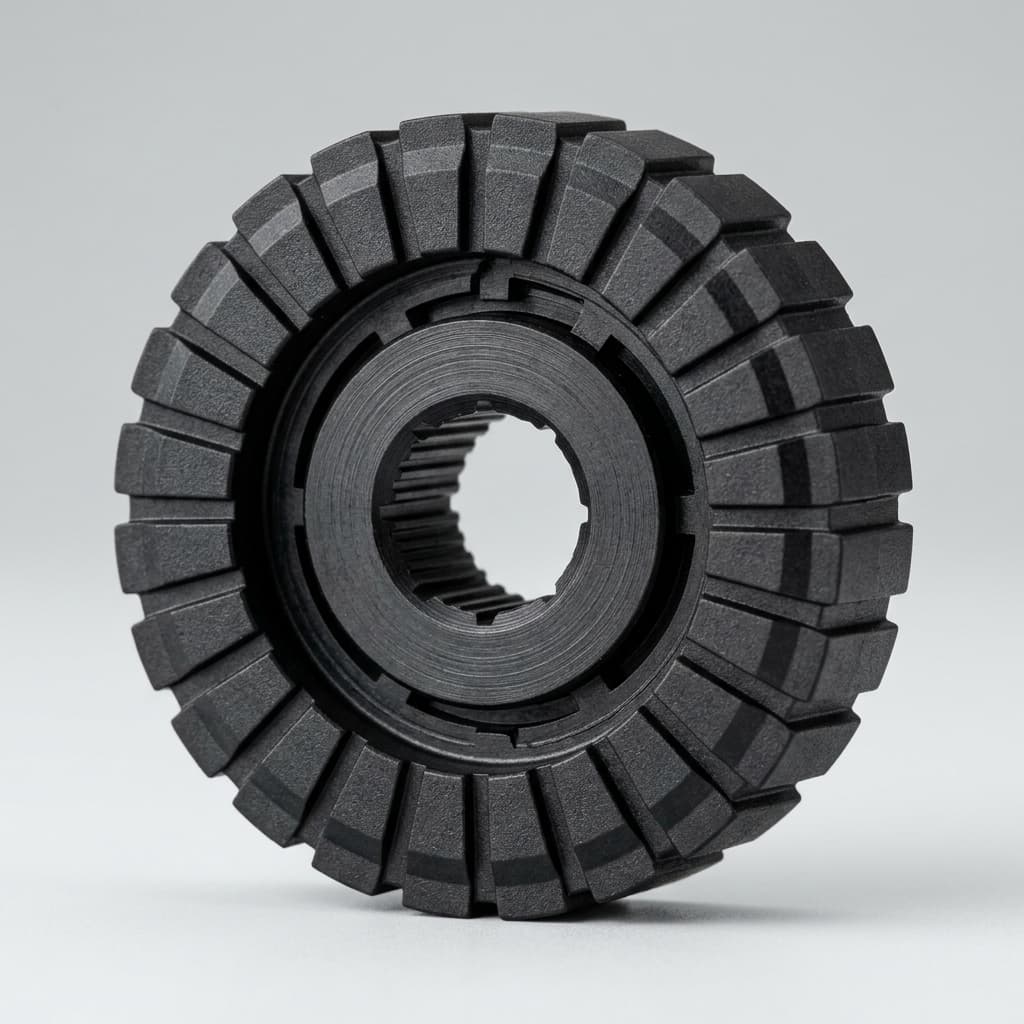
- Complex Geometries: Gears, flanges, asymmetric mounting holes, and snap-fit features can be molded directly into the magnet.
- Net-Shape Tolerances: Parts come out of the mold at their final dimensions. An injection-molded magnetic rotor can easily achieve an Outer Diameter (OD) tolerance of +/- 0.03 mm, and Inner Diameter (ID) tolerances of +/- 0.02 mm. No secondary grinding is required, drastically reducing scrap rates and per-piece manufacturing costs.
3. Insert Molding and Overmolding (The Reliability Game Changer)
Perhaps the biggest advantage of injection molded magnets in automotive applications is the ability to perform insert molding.
Instead of gluing a sintered magnet to a steel shaft or brass hub—which introduces massive reliability risks (adhesive fatigue, thermal shock failure, run-out variance)—you can place the shaft directly into the injection mold. The magnetic material is shot directly around the insert at extreme pressure.
Engineering Benefits of Insert Molding:
- Perfect Concentricity: The mold cavity aligns the shaft and the outer magnetic diameter perfectly. Run-out can be controlled to under 0.05 mm TIR (Total Indicator Reading).
- Mechanical Lock: By knurling or splining the steel shaft, the plastic magnetic material flows into the grooves, creating an unbreakable mechanical lock that withstands severe rotational torque.
- Zero Adhesive Failure: Eliminates the risk of a glued magnet detaching inside a critical automotive system (like an Electronic Expansion Valve) at 150°C.
4. Complex Multi-Pole Magnetization
Automotive encoders (like ABS rings or steering angle sensors) often require dozens of alternating north and south poles on the outer diameter with microscopic transition zones.
- Sintered Rings: Creating a true radial multi-pole sintered ring requires complex, segmented magnetizing fixtures, and the transition zones between poles are often wide and blurry due to the continuous metal crystal structure.
- Molded Rings: Because the magnetic particles are suspended in a polymer matrix, they are physically insulated from one another. Using an electromagnetic orienting fixture inside the mold during injection, the particles can be aligned into highly distinct, sharp multi-pole configurations (e.g., 24, 48, or even 96 poles on a small ring). This results in sharper zero-crossing points, giving the Hall sensor a much cleaner signal to read.
Conclusion
If your application is a high-power BLDC traction motor, you absolutely need the brute force of a sintered magnet. But if you are designing a precise, reliable, and cost-effective automotive sensor rotor or stepper motor, the dimensional stability, insert-molding integration, and multi-pole capabilities of injection molded magnets make them the superior engineering choice.
At Injection Magnets.com, we specialize in the custom tooling, precision insert molding, and mass production of these highly engineered components. If you are starting a new sensor program and need a DFM review for your rotor drawings, contact our engineering team to discuss your material and geometry requirements.
Author

Categories
More Posts
Injection Molded vs. Compression Bonded Magnets: A Procurement and Engineering Guide
Injection molded vs. compression bonded magnets: compare BHmax, tooling, binders, geometry limits, coating risk, and request a DFM review for OEM programs.
Injection Molded Magnet Tolerances: How to Specify Net-Shape Precision Without Cost Overruns
Injection molded magnet tolerances explained: compare standard vs. precision limits, avoid drawing over-specification, and request a DFM review before RFQ.
EU CRMA Compliance 2026: Sourcing Strategies for Injection Molded NdFeB Magnets
Meet EU CRMA 2026 deadlines for permanent magnets. See sourcing, DPP data, and injection molded NdFeB checks to reduce rare-earth compliance risk.