
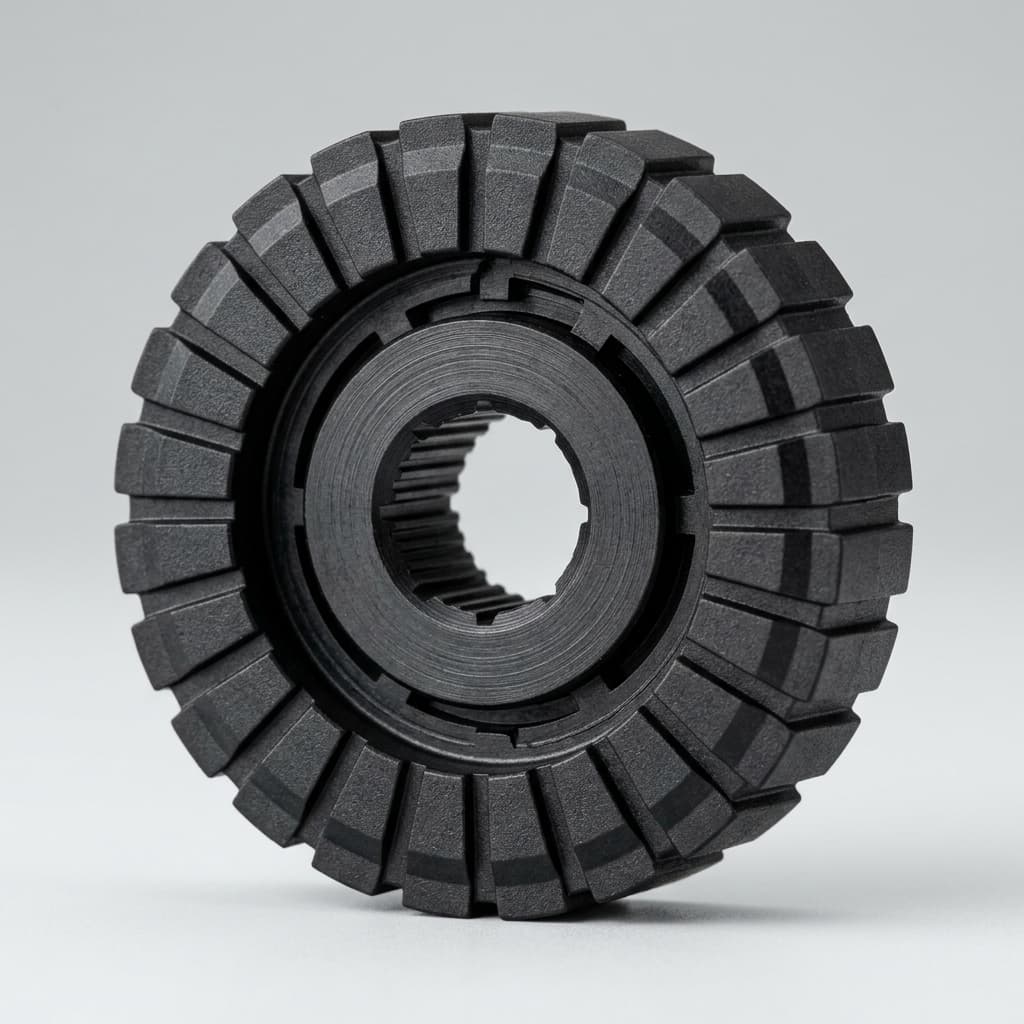
Injection Molded Hybrid Magnets (NdFeB + Ferrite): Balancing Cost and Performance
See when injection molded hybrid magnets balance NdFeB flux with ferrite cost, with limits, sourcing checks, and RFQ guidance.
Injection Molded Hybrid Magnets (NdFeB + Ferrite): Balancing Cost and Performance
For years, automotive engineers and procurement teams have faced a binary choice when specifying magnetic rotors for BLDC motors and high-precision sensors: use Injection Molded Ferrite for low cost, or step up to Injection Molded NdFeB (Neodymium) for high magnetic strength.
However, with the increasing volatility of rare-earth material prices and the drive to secure supply chains, a third option has become the strategic choice for modern manufacturing: Injection Molded Hybrid Magnets.
By blending NdFeB and Ferrite powders within a polymer binder (like PA6, PA12, or PPS), hybrid magnets offer a highly tunable "sweet spot" that balances magnetic performance with material cost. This guide will walk you through when to specify hybrid magnets, how they compare to pure materials, and the engineering checklist you need before your next RFQ.
Reviewed: July 11, 2026. Scope: global OEM sourcing and early-stage engineering selection for thermoplastic injection molded bonded magnets. The ranges below are typical supplier-side planning ranges, not guaranteed grade limits. Final material selection still requires a supplier datasheet, magnetizing fixture plan, and prototype validation in the actual motor or sensor assembly.
1. The Cost vs. Performance Gap
To understand why hybrid magnets exist, we must look at the limitations of the two extremes:
- Pure Injection Molded Ferrite: Extremely cost-effective and resistant to corrosion. However, its low magnetic energy (typically 1.0 - 2.0 MGOe) means you need physically larger magnets to achieve the required torque or sensor resolution, which is often impossible in miniaturized automotive components.
- Pure Injection Molded NdFeB: Offers excellent magnetic strength (4.0 - 10.0 MGOe), enabling highly compact motor designs. The downside? High material costs and exposure to rare-earth market volatility.
The Hybrid Solution: By precisely controlling the ratio of Ferrite to NdFeB powder during the compounding stage, manufacturers can create a material that hits the exact magnetic flux required for your application—without over-specifying and over-paying for pure Neodymium.
2. Material Comparison: Ferrite vs. Hybrid vs. NdFeB
When deciding on a material specification, engineers and buyers should evaluate the following structural differences.
| Property | Pure Injection Molded Ferrite | Hybrid (NdFeB + Ferrite) | Pure Injection Molded NdFeB |
|---|---|---|---|
| Magnetic Energy (BHmax) | ~1.0 - 2.0 MGOe | 2.5 - 5.0 MGOe | 4.0 - 10.0 MGOe |
| Material Cost | Lowest ($) | Medium ($$) | Highest ($$$) |
| Supply Chain Risk | Very Low (Abundant) | Low to Moderate | High (Rare-earth dependent) |
| Temperature Resistance | Excellent (up to 150°C+) | Good (100°C - 150°C) | Moderate (Typically < 120°C for PA binders) |
| Corrosion Resistance | Excellent | Very Good | Good (Requires careful binder selection) |
| Main Design Risk | Larger magnet volume may be needed | Blend validation and magnetizing pattern control | Cost exposure and demagnetization margin |
| Ideal Applications | Basic pumps, cheap encoders | Premium BLDC motors, automotive sensors | High-torque micro-motors, precision actuators |
Note: Temperature resistance, BHmax, and dimensional stability depend on the exact compound, powder loading, anisotropic orientation, binder system, and post-molding magnetization. Treat this table as a screening guide, then confirm with grade-level data and sample testing.
3. Engineering & Procurement Checklist for Specifying Hybrid Magnets
If you are transitioning from a pure NdFeB or Ferrite design to a hybrid solution, use this checklist to ensure a smooth transition with your manufacturing partner:
- Define the Minimum Flux Requirement: Do not over-specify. Identify the absolute minimum magnetic flux required at the sensor IC or motor air gap. This dictates the NdFeB-to-Ferrite ratio.
- Specify the Operating Environment: Will the magnet be exposed to ATF (Automatic Transmission Fluid), oil, or extreme heat? This will determine if you need a PA12 or PPS binder.
- Evaluate Insert Molding Potential: Hybrid materials flow exceptionally well during injection molding. Consider overmolding the hybrid magnet directly onto your steel shaft or rotor hub to eliminate secondary assembly steps.
- Check Dimensional Tolerances: Ensure the shrinkage rate of the specific hybrid compound is accounted for in the mold design. Injection molding typically achieves net-shape tolerances of ±0.05mm without secondary machining.
- Request a Prototype Run: Because magnetic properties in hybrids are tunable, request a prototype using a 50/50 blend and a 70/30 blend to physically test the performance in your assembly.
- Lock the Acceptance Test: Define how production lots will be accepted: surface flux at a fixed air gap, full magnetic map, torque constant, sensor output, or another assembly-level metric.
4. Frequently Asked Questions (FAQ)
Q: Can I replace an existing sintered NdFeB magnet with an injection molded hybrid magnet? A: Rarely a drop-in replacement. Sintered NdFeB is vastly stronger (35+ MGOe). Switching to any injection molded magnet (even pure NdFeB) requires a redesign of the magnetic circuit, usually by increasing the magnet's volume or moving it closer to the sensor.
Q: Does adding Ferrite powder make the magnet more brittle? A: No. The mechanical strength of an injection molded magnet is primarily determined by the polymer binder (Nylon or PPS), not the magnetic powder. Hybrid magnets maintain excellent impact resistance.
Q: How does the pricing of hybrid magnets scale with volume? A: Injection molding is highly favorable for mass production (100,000+ parts/year). While the initial tooling cost for the mold is significant, the piece price drops dramatically at volume, and the hybrid material offers a much more stable long-term price than pure NdFeB.
Q: When should I avoid a hybrid NdFeB + Ferrite compound? A: Avoid it when the package cannot grow, the air gap is already fixed, or the design needs sintered NdFeB-level energy density. In those cases, a hybrid compound may reduce cost on paper but fail the torque, Hall signal, or demagnetization margin in the actual assembly.
5. Conclusion: Ready to Optimize Your Magnetic Rotor?
Reducing rare-earth dependency isn't just an environmental initiative; it's a critical procurement strategy. By leveraging injection molded hybrid magnets, engineers can maintain tight dimensional tolerances and strong magnetic fields while drastically reducing material costs.
Need help specifying the exact NdFeB-to-Ferrite ratio for your application? Our engineering team specializes in custom magnetic compounds and multi-cavity injection molding. Contact us today for a technical consultation and tooling quote.
Sources / References
- Alliance LLC: hybrid molded ferrite materials and NdFeB/ferrite blend positioning. Hybrid Molded Ferrite Magnets
- Arnold Magnetic Technologies: injection molded magnet process overview for bonded magnetic components. Injection Molded Magnets
- Maglastic: supplier overview for bonded and injection molded magnetic material options. Maglastic
- Mishma Magnet: supplier overview for bonded magnet applications in motors and automation. Mishma Magnet
Author

Categories
More Posts

Overcoming Demagnetization: High-Temperature Stability of Bonded NdFeB
Demagnetization at high temperatures is a critical failure mode in EV and automotive motors. Learn how Intrinsic Coercivity (Hcj) and polymer binders dictate the thermal survival of molded NdFeB magnets.
Injection Molded Magnet Tolerances: How to Specify Net-Shape Precision Without Cost Overruns
Injection molded magnet tolerances explained: compare standard vs. precision limits, avoid drawing over-specification, and request a DFM review before RFQ.
Injection Molded Magnets vs. Sintered Magnets: A Complete Guide for Automotive Sensors
Discover the critical differences between injection molded magnets and sintered magnets. Learn why automotive sensor engineers increasingly prefer molded magnetic rotors for precision, cost-efficiency, and complex geometries.